Table of Contents
ToggleBest Baby Thermometers Australia 2026: Accurate Temperature Checks
When your baby feels warm, having a reliable thermometer is essential. Australian parents need accurate, easy-to-use thermometers that work quickly—especially at 2 AM when your little one is unsettled. This guide covers the best baby thermometers available in Australia in 2026, from digital stick thermometers to infrared forehead scanners.
Why Accurate Temperature Measurement Matters
Fever is one of the most common reasons parents contact a GP. But not all fevers require medical attention, and knowing your baby’s exact temperature helps you make informed decisions about when to seek care.
When to see a doctor:
– Baby under 3 months with any fever (38°C or higher)
– Temperature above 39°C in babies 3-6 months
– Fever lasting more than 3 days
– Baby is unusually lethargic or irritable
– Difficulty breathing or feeding
The right thermometer gives you confidence in your readings and helps you communicate clearly with healthcare professionals.
Types of Baby Thermometers
Digital Stick Thermometers
Traditional digital thermometers measure temperature when held under the arm (axillary), in the mouth (oral), or rectally. For babies and young children, underarm measurement is safest and most comfortable.
PROS
-
Highly accurate (±0.1°C)
-
Affordable ($10-$30)
-
No batteries to replace
-
Long-lasting
CONS
-
Takes 1-3 minutes to measure
-
Requires baby to stay still
-
Harder to use on wriggly toddlers
WHO IT'S BEST FOR
-
Accurate underarm readings, budget-friendly
Infrared Forehead Thermometers
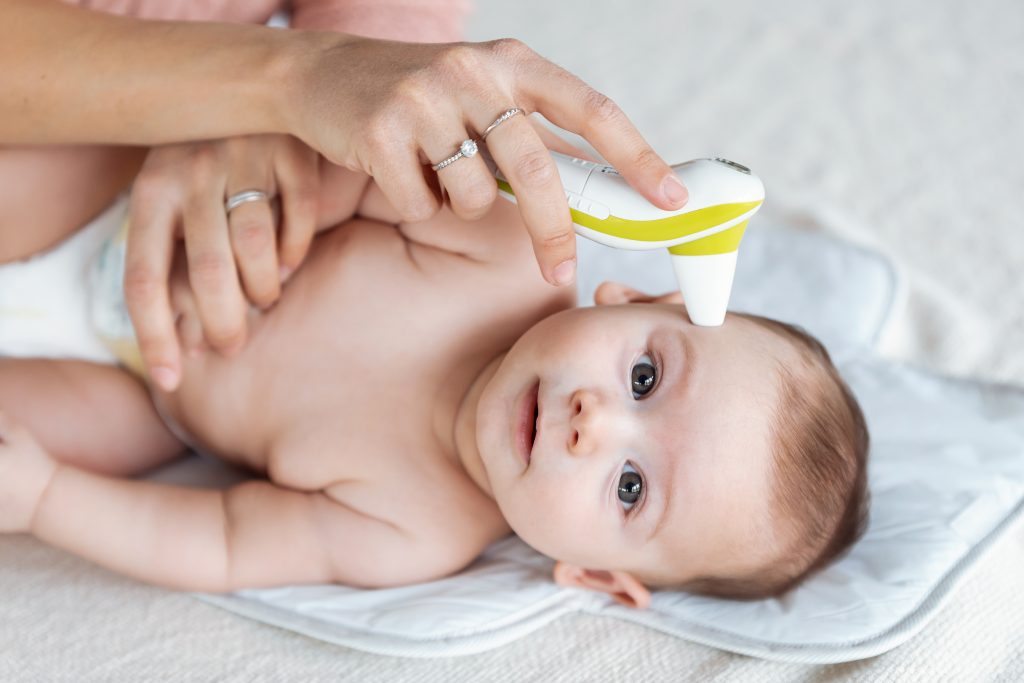
Infrared thermometers measure the heat radiating from the temporal artery in the forehead. They’re fast (1-2 seconds) and non-contact, making them ideal for sleeping children or quick checks.
PROS
-
Results in 1-2 seconds
-
No contact needed (some models)
-
Hygienic—no cleaning between uses
-
Easy to use on sleeping babies
CONS
-
More expensive ($40-$120)
-
Can be affected by room temperature
-
Less accurate if baby is sweating or moving
-
Requires proper positioning
WHO IT'S BEST FOR
-
Quick checks, sleeping babies
Ear (Tympanic) Thermometers
Ear thermometers measure infrared heat from the eardrum. They’re fast and accurate but require correct positioning—the probe must have a clear view of the eardrum.
PROS
-
Very quick (2-3 seconds)
-
Accurate when used correctly
-
Comfortable for older babies
-
Reusable probe covers
CONS
-
Not suitable for babies under 6 months (small ear canals)
-
Earwax can affect accuracy
-
Requires proper angle and positioning
-
More expensive ($50-$100)
WHO IT'S BEST FOR
-
Older babies (6+ months), quick readings
Smart Thermometers
Smart thermometers connect to your smartphone via Bluetooth, allowing you to track temperature trends, set medication reminders, and share data with your GP.
PROS
-
Track temperature history
-
Set medication reminders
-
Share data with doctors
-
Multiple user profiles
CONS
-
Most expensive option ($80-$150)
-
Requires smartphone app
-
Battery dependent
-
May have subscription features
WHO IT'S BEST FOR
-
Tech-savvy parents, tracking trends
Best Baby Thermometers in Australia 2026
1. Braun ThermoScan 7 Ear Thermometer
Best Overall Ear Thermometer
The Braun ThermoScan 7 is our best-overall ear thermometer pick. Its patented Age Precision feature adjusts the fever guidance based on your child’s age, helping you understand whether a temperature is concerning for a newborn versus a toddler.
Key features:
– Pre-warmed tip for accurate readings
– Age Precision technology (0-3 months, 3-36 months, 36+ months)
– Color-coded display (green/yellow/red)
– Stores last 9 readings
– 1-second reading time
Why it’s great: The pre-warmed tip minimizes cooling of the ear canal, giving more accurate results. The age-based guidance removes guesswork—you’ll know if your baby’s temperature is normal, elevated, or high for their specific age.
Price: $90-$110 AUD
2. Withings Thermo Smart Temporal Thermometer
Best Smart Thermometer
The Withings Thermo uses 16 infrared sensors to take 4,000 measurements along the temporal artery, providing hospital-grade accuracy. The accompanying app tracks temperature trends and lets you add symptoms, medications, and photos.
Key features:
– No-contact measurement (1-2 seconds)
– 16 infrared sensors for accuracy
– Automatic sync to smartphone app
– Multiple user profiles (up to 8 family members)
– Medication reminders
– Data export for doctors
Why it’s great: Perfect for parents who want detailed tracking. The app makes it easy to spot patterns (fever spikes at night, response to medication) and share comprehensive data with your GP.
Price: $130-$150 AUD
3. Beurer FT 90 Non-Contact Thermometer
Best Budget Infrared Thermometer
The Beurer FT 90 offers infrared accuracy at an affordable price. It can measure body temperature from the forehead without contact, plus doubles as an object thermometer (great for checking bath water or bottle temperature).
Key features:
– Non-contact measurement (5-6 cm distance)
– 1-second reading
– Color-coded fever alarm
– Stores 60 measurements
– Object temperature mode
– Silent mode for sleeping babies
Why it’s great: Excellent value for money. The non-contact feature is perfect for newborns and the silent mode won’t wake a sleeping baby. The object temperature function is surprisingly useful for bath time.
Price: $40-$60 AUD
4. Omron MC-720 Digital Thermometer
Best Budget Digital Thermometer
The Omron MC-720 is a reliable, no-frills digital thermometer that provides accurate axillary (underarm) readings. It’s waterproof, has a flexible tip for comfort, and beeps when the reading is complete.
Key features:
– Flexible tip for comfort
– 30-second reading (predictive mode)
– Waterproof and easy to clean
– Fever alarm
– Auto shut-off
– 5-year warranty
Why it’s great: Simple, reliable, and affordable. Perfect as a backup thermometer or for parents who prefer traditional methods. The flexible tip is gentler on wriggly babies.
Price: $12-$20 AUD
5. Kinetik Digital Ear & Forehead Thermometer
Best Dual-Mode Thermometer
The Kinetik combines ear and forehead measurement in one device, giving you flexibility based on your child’s age and situation. Switch between modes depending on whether your baby is asleep (forehead) or awake (ear).
Key features:
– Dual measurement mode (ear or forehead)
– 1-second reading time
– Silent mode
– Backlit display for night-time use
– Stores 32 readings
– Comes with ear probe covers
Why it’s great: Versatility. Use forehead mode for newborns and sleeping babies, then switch to ear mode for faster readings on older children. The silent feature is perfect for midnight temperature checks.
Price: $50-$70 AUD
How to Take Accurate Temperature Readings
Underarm (Axillary) Method
1. Make sure the armpit is dry
2. Place the thermometer tip in the center of the armpit
3. Hold your baby’s arm firmly against their body
4. Wait for the beep (usually 30-90 seconds)
5. Add 0.5°C to the reading for core temperature
Tip: Do this before feeding or bathing—activity raises body temperature.
Forehead (Temporal) Method
1. Remove hats and ensure the forehead is dry
2. Hold the thermometer 2-5 cm from the forehead (check manufacturer’s instructions)
3. Press the button and hold steady for 1-2 seconds
4. Read the result immediately
Tip: Wipe away sweat first—moisture affects infrared readings.
Ear (Tympanic) Method
1. Use a fresh probe cover
2. Gently pull the outer ear up and back to straighten the ear canal
3. Insert the probe snugly into the ear canal
4. Press the button and hold for 1 second
5. Remove and read
Tip: Not recommended for babies under 6 months—their ear canals are too small for accurate readings.
What Temperature is a Fever?
Normal body temperature ranges from 36.5°C to 37.5°C, but this varies throughout the day and depends on measurement method.
Fever thresholds by age and method:
Babies 0-3 months:
– Underarm: 37.5°C or higher → Call doctor immediately
– Rectal: 38°C or higher → Seek urgent care
Babies 3-6 months:
– Underarm: 38°C or higher → Contact GP
– Rectal: 38.5°C or higher → Contact GP
Babies 6+ months:
– Underarm: 38°C or higher → Monitor and give fluids
– Ear/forehead: 38.5°C or higher → Contact GP if persistent
Important: Any fever in a baby under 3 months requires immediate medical attention, even if they seem otherwise well.
Tips for Choosing the Right Thermometer
Consider Your Baby’s Age
– Newborns (0-3 months): Digital underarm or non-contact forehead thermometer
– Babies (3-12 months): Forehead thermometer for quick checks, digital for confirmation
– Toddlers (12+ months): Ear thermometer (once ear canals are large enough)
Think About Usage Frequency
– Occasional use: Budget digital thermometer ($15-$25)
– Frequent monitoring (chronic illness): Smart thermometer with tracking ($100-$150)
– Multiple children: Infrared forehead thermometer (hygienic, no contact)
Prioritize Ease of Use
If you’re measuring temperature on a wriggly toddler at 3 AM, you need something that works quickly and reliably. Infrared thermometers are worth the extra cost if they make night-time temperature checks less stressful.
Check Battery Requirements
Infrared and smart thermometers need batteries. Keep spares on hand—you don’t want a dead battery during a fever emergency.
Thermometer Accuracy: What You Need to Know
No thermometer is 100% accurate, but quality models are reliable within ±0.2°C to ±0.3°C.
Factors that affect accuracy:
– Room temperature: Very cold or hot rooms can affect infrared readings
– Sweating: Moisture on the forehead reduces accuracy
– Movement: Wriggly babies make it hard to get a good reading
– Ear wax: Blocks the infrared sensor in ear thermometers
– Positioning: Incorrect angle or distance affects results
Pro tip:Take multiple readings and use the average. If the first reading seems off, wait 5 minutes and try again.
Maintaining Your Thermometer
Digital Thermometers
– Clean with rubbing alcohol after each use
– Store in the protective case
– Replace batteries annually
– Test accuracy against a known reference
Infrared Thermometers
– Clean the lens with a soft, dry cloth
– Avoid touching the sensor
– Store away from direct sunlight
– Calibrate according to manufacturer instructions
– Replace batteries when “low battery” indicator appears
Ear Thermometers
– Use a new probe cover every time
– Clean the probe gently with alcohol
– Keep spare probe covers on hand
– Don’t use if probe is damaged
When to Upgrade Your Thermometer
Replace your thermometer if:
– It gives inconsistent readings (varies by >0.5°C on repeat measurements)
– The display is damaged or hard to read
– It’s more than 5 years old
– Batteries drain unusually fast
– You’ve dropped it multiple times
Modern thermometers are more accurate and user-friendly than older models, so upgrading every few years is worthwhile.
Shop Baby Thermometers on Amazon
View Beurer FT65 Ear & Forehead Thermometer on Amazon
View Digital Infrared Thermometer on Amazon
View Braun ThermoScan 7 Black Edition on Amazon
Frequently Asked Questions
Are forehead thermometers as accurate as ear thermometers?
High-quality forehead thermometers are accurate within ±0.2°C, similar to ear thermometers. However, ear thermometers are less affected by environmental factors like room temperature.
Can I use a regular thermometer on my baby?
Yes, but baby-specific thermometers have features that make them easier to use—flexible tips, faster readings, and age-based guidance. They’re worth the investment for peace of mind.
Do I need to add a degree to underarm readings?
Underarm (axillary) temperatures are typically 0.5-1°C lower than core body temperature. Some thermometers adjust automatically; others require you to add 0.5°C mentally. Check your thermometer’s manual.
Which method is most accurate for babies?
Rectal temperature is the gold standard for babies under 3 months, but underarm (digital) and ear (for older babies) are sufficiently accurate for home use. Forehead thermometers are great for quick checks but confirm high readings with a digital thermometer.
How often should I check my baby’s temperature?
Only check when your baby seems unwell (hot forehead, flushed cheeks, irritable). Frequent checking isn’t necessary if your baby is eating, sleeping, and behaving normally.
Can I use a thermometer on a sleeping baby?
Yes! Non-contact forehead thermometers are perfect for this. Set it to silent mode and take the reading without waking your baby.
The Bottom Line
The best baby thermometer for your family depends on your budget, your baby’s age, and how often you need to check temperatures. For most Australian parents, an infrared forehead thermometer like the **Beurer FT 90** offers the best balance of speed, accuracy, and value.
If you have a newborn or frequently need to monitor fevers, investing in the Braun ThermoScan 7 or Withings Thermo Smart provides hospital-grade accuracy and helpful features like temperature tracking and age-based guidance.
And every parent should have a basic Omron digital thermometer as a backup—they’re affordable, reliable, and don’t require batteries.
Remember: A thermometer is just a tool. Trust your instincts—if your baby seems unwell beyond just a mild fever, contact your GP or call Healthdirect on 1800 022 222 for 24/7 advice.
Looking for more baby essentials? Check out our guides to the [best baby monitors](#), [best nappy bags](#), and [hospital bag checklist](#) for Australian parents.